My Wishlist

View your shopping bag

Items: (0) £0.00
  • £
  • $
  • €

Checkout

Cell Division

  • Grid View
  • List View
3D1.1 Antibody (Parathyroid hormone like protein) - Mouse Anti PTHLH
The protein encoded by this gene is a member of the parathyroid hormone family. This hormone regulates endochondral bone development and epithelial-mesenchymal interactions during the formation of the mammary glands and teeth. This hormone is involved in lactation possibly by regulating the mobilization and transfer of calcium to the milk. The receptor of this hormone, PTHR1, is responsible for most cases of humoral hypercalcemia of malignancy. Four alternatively spliced transcript variants encoding two distinct isoforms have been observed. There is also evidence for alternative translation initiation from non-AUG (CUG and GUG) start sites, in-frame and downstream of the initiator AUG codon, to give rise to nuclear forms of this hormone
£226.00

Buy | View ›

APPL1 Antibody - Rabbit Anti-APPL1 50ul
The protein encoded by this gene has been shown to be involved in the regulation of cell proliferation and in the crosstalk between the adiponectin signalling and insulin signalling pathways The encoded protein binds many other proteins including RAB5A DCC AKT2 PIK3CA adiponectin receptors and proteins of the NuRD/MeCP1 complex This protein is found associated with endosomal membranes but can be released by EGF and translocated to the nucleus
£226.00

Buy | View ›

Aurora B Antibody - Sheep Anti- Aurora B 0.2ml
Aurora B is a mitotic protein kinase that phosphorylates histone H3 (probably on Serine 10) behaves as a chromosomal passenger protein and may regulate several stages of mitosis such as centrosome separation chromosome segregation and cytokinesis It localizes to the inner centromere region from prophase to anaphase
£226.00

Buy | View ›

BUB1 Antibody - Mouse (monoclonal) Anti-BUB1 0.1ml
Bub1 is a kinase involved in spindle checkpoint function The kinase functions in part by phosphorylating a member of the miotic checkpoint complex and activating the spindle checkpoint Mutations in Bub1 have been associated with aneuploidy and several forms of cancer
£226.00

Buy | View ›

BUB1 Antibody - Mouse Anti-BUB1 50ul
Bub1 is a kinase involved in spindle checkpoint function The kinase functions in part by phosphorylating a member of the miotic checkpoint complex and activating the spindle checkpoint Mutations in Bub1 have been associated with aneuploidy and several forms of cancer
£183.00

Buy | View ›

CENP-E Antibody - Mouse Anti-CENP-E 0.1ml
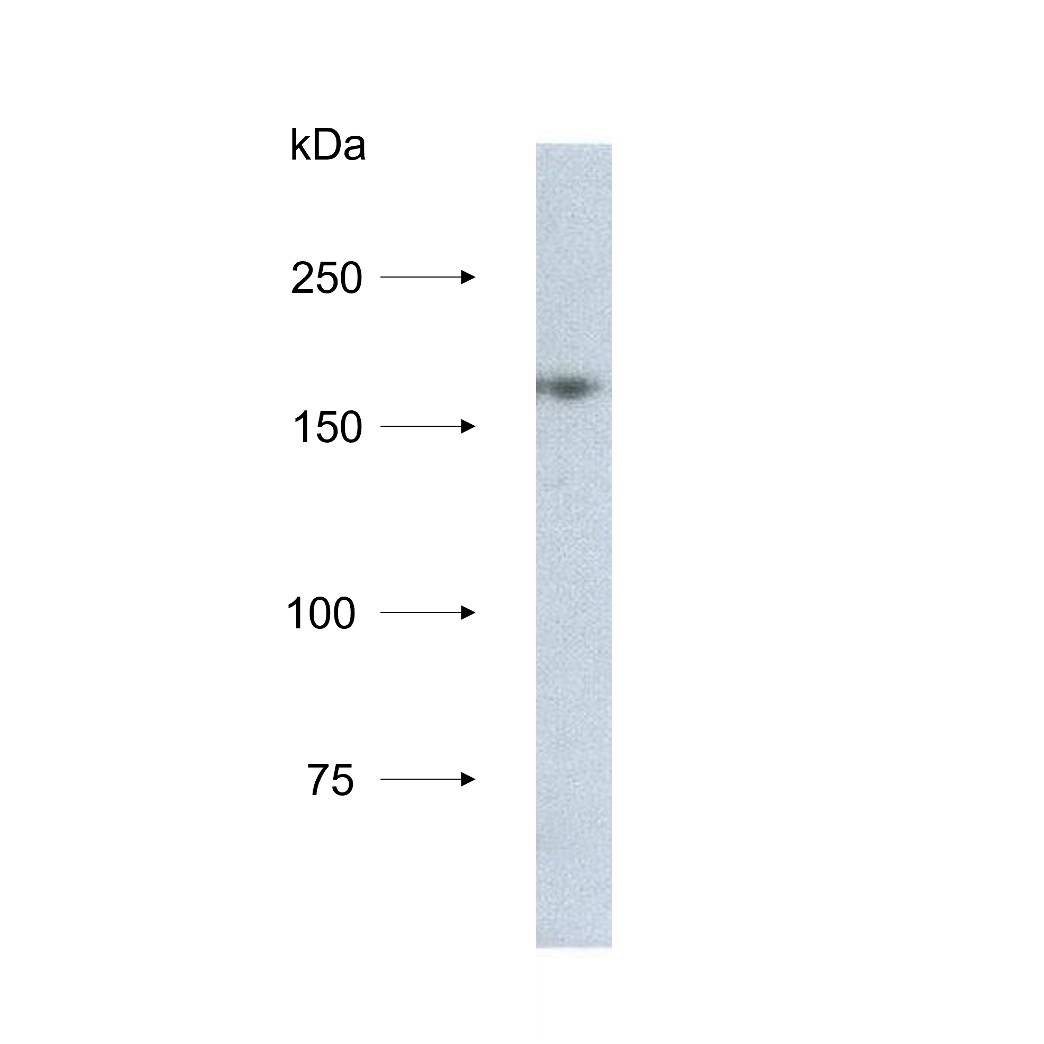
CENPE is a 250-300 kDa human centromere-associated kinesin-like motor protein that accumulates in G2 phase In contrast to other centromere proteins CENPE is not detected at centromeres during interphase and first appears at the centromere region of chromosomes during prometaphase CENPE function is required for the transition from metaphase to anaphase CENPE is probably one of the motors responsible for mammalian chromosome movement and/or spindle elongation
£226.00

Buy | View ›

CENP-E Antibody - Mouse Anti-CENP-E 50ul
CENPE is a 250-300 kDa human centromere-associated kinesin-like motor protein that accumulates in G2 phase In contrast to other centromere proteins CENPE is not detected at centromeres during interphase and first appears at the centromere region of chromosomes during prometaphase CENPE function is required for the transition from metaphase to anaphase CENPE is probably one of the motors responsible for mammalian chromosome movement and/or spindle elongation
£183.00

Buy | View ›

EAPP Antibody ; Mouse Anti-EAPP
Transcription activator that binds DNA cooperatively with dp proteins through the E2 recognition site, 5'-TTTC[CG]CGC-3' found in the promoter region of a number of genes whose products are involved in cell cycle regulation or in DNA replication. The DRTF1/E2F complex functions in the control of cell-cycle progression from G1 to S phase. E2F-1 binds preferentially RB1 protein, in a cell-cycle dependent manner. It can mediate both cell proliferation and p53-dependent apoptosis
£226.00

Buy | View ›

HDAC1 Antibody ; Mouse Anti-HDAC1
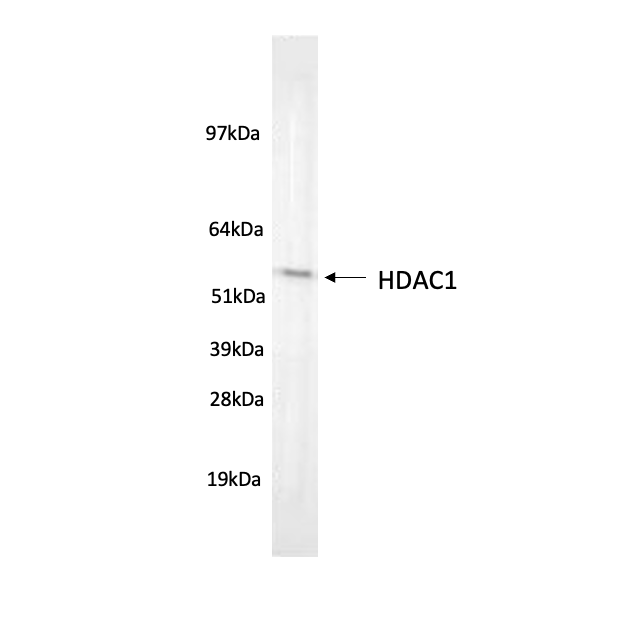
Responsible for the deacetylation of lysine residues on the N-terminal part of the core histones (H2A, H2B, H3 and H4). Histone deacetylation gives a tag for epigenetic repression and plays an important role in transcriptional regulation, cell cycle progression and developmental events. Histone deacetylases act via the formation of large multiprotein complexes. Deacetylates SP proteins, SP1 and SP3, and regulates their function. Component of the BRG1-RB1-HDAC1 complex, which negatively regulates the CREST-mediated transcription in resting neurons. Upon calcium stimulation, HDAC1 is released from the complex and CREBBP is recruited, which facilitates transcriptional activation. Deacetylates TSHZ3 and regulates its transcriptional repressor activity
£226.00

Buy | View ›

HDAC3 Antibody ; Mouse Anti-HDAC3
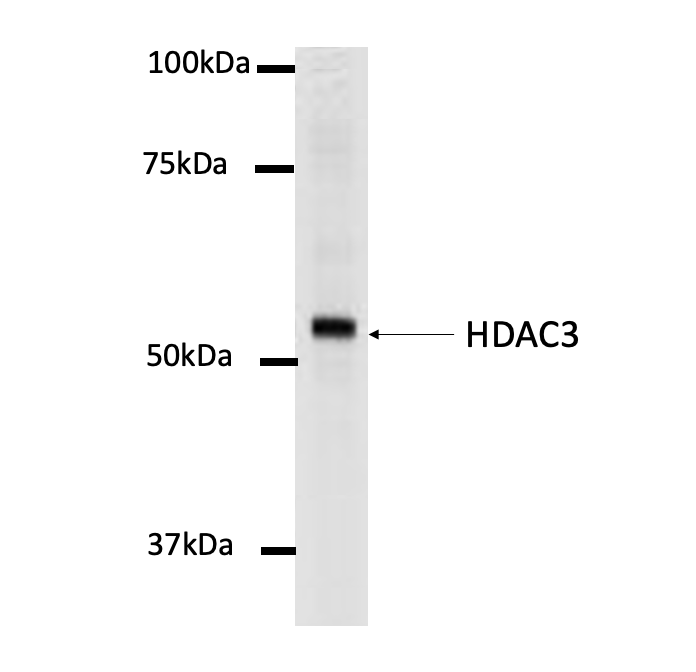
Responsible for the deacetylation of lysine residues on the N-terminal part of the core histones (H2A, H2B, H3 and H4). Histone deacetylation gives a tag for epigenetic repression and plays an important role in transcriptional regulation, cell cycle progression and developmental events. Histone deacetylases act via the formation of large multiprotein complexes. Probably participates in the regulation of transcription through its binding to the zinc-finger transcription factor YY1; increases YY1 repression activity. Required to repress transcription of the POU1F1 transcription factor. Acts as a molecular chaperone for shuttling phosphorylated NR2C1 to PML bodies for sumoylation
£226.00

Buy | View ›

Histone H4 Me1K20 Antibody ; Mouse Anti-Histone H4 Me1K20
Histone proteins H3, H4, H2A, and H2B function as building blocks to package eukaryotic DNA into repeating nucleosome units that are folded in higher order chromatin fibers. The nucleosome is composed of an octamer containing a H3/H4 tetramer and two H2A/H2B dimers, surrounded by approximately 146 base pairs of DNA. A diverse and elaborate array of post-translational modifications including acetylation, phosphorylation, methylation, ubiquitination, and ADP-ribosylation occurs on the N-terminal tail domains of histones. Methylation of position-specific lysine residues in histone N termini is a central modification for regulating epigenetic transitions in chromatin. Each methylatable lysine residue can exist in a mono, di, or tri methylated state. Arginine resdiues can also by mono or di methylated
£226.00

Buy | View ›

Insulin Like Growth Factor Antibody - Mouse Anti-Insulin Like Growth Factor (IGF-1)
Insulin is a pancreatic hormone that regulates glucose uptake and the synthesis of protein and fat. The insulin like growth factors, isolated from plasma, are structurally and functionally related to insulin but have a much higher growth promoting activity. IGF1 (Insulin Like Growth Factor I) is a polypeptide growth factor, which stimulates the proliferation of a wide range of cell types including muscle, bone, and cartilage tissue. IGF1 functions as an autocrine regulator of growth
£226.00

Buy | View ›

Lamin A Antibody - Mouse Anti-Lamin A
Nuclear lamins form a network of intermediate-type filaments at the nucleoplasmic site of the nuclear membrane Two main subtypes of nuclear lamins can be distinguished ie A type lamins and B type lamins The A type lamins comprise a set of three proteins arising from the same gene by alternative splicing ie lamin A lamin C and lamin Adel 10 while the B type lamins include two proteins arising from two distinct genes ie lamin B1 and lamin B2 Recent evidence has revealed that mutations in A-type lamins give rise to a range of rare but dominant genetic disorders including Emery-Dreifuss muscular dystrophy dilated cardiomyopathy with conduction-system disease and Dunnigan-type familial partial lipodystrophy In addition the expression of A type lamins coincides with cell differentiation and as A type lamins specifically interact with chromatin a role in the regulation of differential gene expression has been suggested for A type lamins
£183.00

Buy | View ›

Lamin A Antibody- Mouse Anti-Lamin A
Nuclear lamins form a network of intermediate-type filaments at the nucleoplasmic site of the nuclear membrane Two main subtypes of nuclear lamins can be distinguished ie A type lamins and B type lamins The A type lamins comprise a set of three proteins arising from the same gene by alternative splicing ie lamin A lamin C and lamin Adel 10 while the B type lamins include two proteins arising from two distinct genes ie lamin B1 and lamin B2 Recent evidence has revealed that mutations in A-type lamins give rise to a range of rare but dominant genetic disorders including Emery-Dreifuss muscular dystrophy dilated cardiomyopathy with conduction-system disease and Dunnigan-type familial partial lipodystrophy In addition the expression of A type lamins coincides with cell differentiation and as A type lamins specifically interact with chromatin a role in the regulation of differential gene expression has been suggested for A type lamins
£226.00

Buy | View ›

Lamin A Antibody- Mouse Anti-Lamin A
Nuclear lamins form a network of intermediate-type filaments at the nucleoplasmic site of the nuclear membrane Two main subtypes of nuclear lamins can be distinguished ie A type lamins and B type lamins The A type lamins comprise a set of three proteins arising from the same gene by alternative splicing ie lamin A lamin C and lamin Adel 10 while the B type lamins include two proteins arising from two distinct genes ie lamin B1 and lamin B2 Recent evidence has revealed that mutations in A-type lamins give rise to a range of rare but dominant genetic disorders including Emery-Dreifuss muscular dystrophy dilated cardiomyopathy with conduction-system disease and Dunnigan-type familial partial lipodystrophy In addition the expression of A type lamins coincides with cell differentiation and as A type lamins specifically interact with chromatin a role in the regulation of differential gene expression has been suggested for A type lamins
£183.00

Buy | View ›

Lamin A/C - Mouse Anti-Lamin A/C
Nuclear Lamins form a network of intermediate-type filaments at the nucleoplasmic site of the nuclear membrane Two main subtypes of nuclear lamins can be distinguished ie A-type Lamins and B-type Lamins The A-type Lamins comprise a set of three proteins arising from the same gene by alternative splicing ie Lamin A Lamin C and Lamin Adel 10 while the B-type Lamins include two proteins arising from two distinct genes ie Lamin B1 and Lamin B2 Recent evidence has revealed that mutations in A-type Lamins give rise to a range of rare but dominant genetic disorders including Emery-Dreifuss muscular dystrophy dilated cardiomyopathy with conduction-system disease and Dunnigan-type familial partial lipodystrophy In addition the expression of A-type Lamins coincides with cell differentiation and as A-type Lamins specifically interact with chromatin a role in the regulation of differential gene expression has been suggested for A-type Lamins
£183.00

Buy | View ›

View: 16 / 32 / 48 / 64 / All / products per page

« previous 1 2 3 4 5 next »